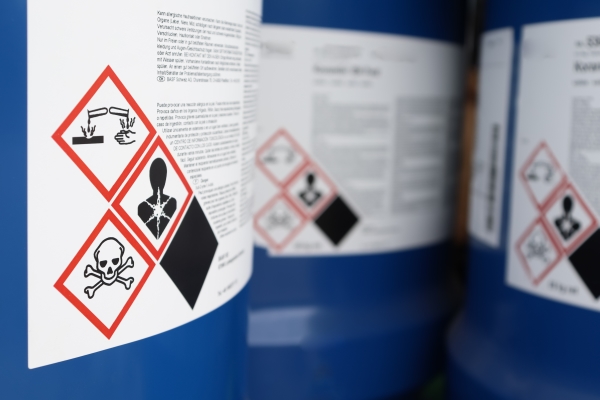
Dangerous goods labels from HERMA
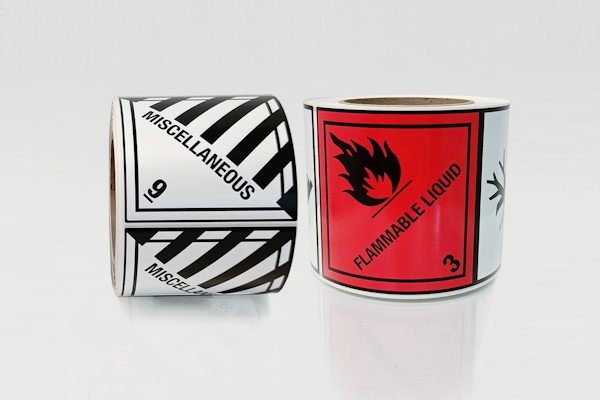
HERMA manufactures dangerous goods labels for the marking of consignments, containers and transport packaging: seawater-resistant, chemical-resistant and with secure adhesion to steel drums, plastic canisters, IBCs, big bags and containers. The chemical, pharmaceutical, agricultural, logistics and retail sectors rely on adhesive materials and printing from a single source. We produce large quantities to individual specifications in-house, whilst standard formats are available through our partnership with BOXLAB Services from as little as one item.
When dangerous goods labels are mandatory
Dangerous goods labels are always mandatory whenever dangerous goods leave the premises and are transported. The decisive factor is not how hazardous a substance is to handle, but the risk it poses during transport. As soon as a substance is classified as a dangerous good, the labelling must comply with the regulations of the relevant mode of transport.
For your procurement, this has two implications. Firstly, the layouts of the hazard labels are harmonised across all sets of regulations, meaning that a correctly designed label can be used across multiple transport routes. Secondly, the regulations are continuously updated: the ADR every two years, and the IATA DGR annually. Anyone who keeps a stock of dangerous goods labels therefore runs the risk of working with outdated layouts. The Federal Institute for Materials Research and Testing (BAM) provides a consolidated overview of all applicable dangerous goods regulations on its ‘Technical Safety’ portal: BAM dangerous goods regulations.
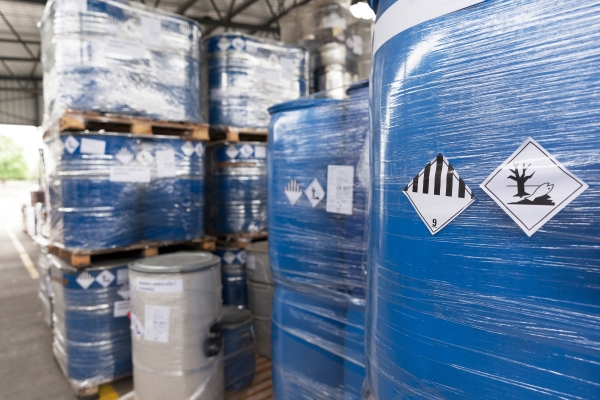


Hazardous substance labels or dangerous goods labels: what is the difference?
The two terms are often used interchangeably, but refer to two distinct areas of law. Under the CLP Regulation, hazardous substance labels indicate the hazards associated with handling a chemical and storing it on the premises. Under transport legislation, dangerous goods labels indicate the hazards that arise during transport. As a rule of thumb: a hazardous substance becomes a dangerous good as soon as it leaves the premises and is transported.
Dangerous goods labels
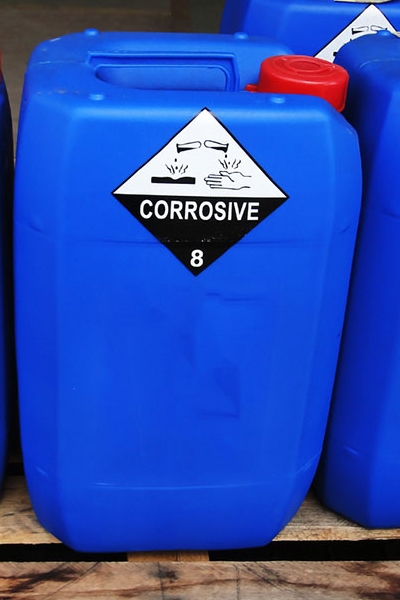
- standardised appearance (diamond with image and text)
- adherence to legally prescribed layouts and sizes – important for legal compliance
- ready-printed, in the case of placards sometimes printed with UN number

- blank labels or labels with pre-printed red diamond frames
- individual information is printed by the user (product name, batch number, identifier, etc.)
- various formats and materials, low level of standardisation, therefore usually custom products
In practice, both types of labelling are often found on the same container. The GHS label in accordance with CLP does not replace the ADR hazard label; both serve different purposes. Article 33 of the CLP Regulation governs how they interact in the case of multi-part consignments: If the outer packaging complies with the labelling requirements for the transport of dangerous goods, the inner and intermediate packaging must be labelled in accordance with CLP. If the hazard pictogram and transport labelling relate to the same hazard, the GHS pictogram does not need to be affixed to the outer packaging as well.
Dangerous goods labels from HERMA and BOXLAB Services
For dangerous goods labelling, HERMA collaborates with BOXLAB Services, a specialist in dangerous goods labelling and packaging materials spun off from BASF SE and based in Ludwigshafen. The division of responsibilities is clearly defined: the adhesive material is supplied by HERMA; die-cutting and printing take place at the HERMA production facility; whilst BOXLAB Services handles assembly and dispatch. This ensures you receive the label quality you have come to expect, combined with the ability to supply even the smallest quantities.
BOXLAB Services works in partnership with dangerous goods consultants to ensure that the printed layouts comply with the latest regulations. This takes the pressure off you in the area where dangerous goods labelling is most prone to errors: the constant changes to the regulations. In addition, BOXLAB Services offers process consultancy throughout the entire supply chain, from order processing through to warehousing, handling and disposal.
Bespoke production in large quantities
If you require dangerous goods labels in custom formats, with specific material requirements or in large print runs, HERMA will produce them directly for you. We tailor the film, adhesive and print finish to your containers and process conditions, including hot-fill applications, curved surfaces, and shrink and stretch films. Please contact us via the enquiry form; we’ll advise you on the choice of materials.
Standard formats from as little as one item
You can order hazard labels, placards and warning signs in the prescribed standard formats via the BOXLAB Services shop, from as little as one item and with express delivery within 24 hours across Europe. Thanks to our stock management and consolidated production, you no longer need to hold your own stock, and you’ll always be working with the currently valid layout. Customised printing, such as UN numbers or technical designations, is also possible. You can find the full range on our page dedicated to hazard labels and placards
Buy hazardous goods labels in standard formats: legally compliant, available quickly, and of the highest quality
Find out more about our partnership with BOXLAB Services and our range of hazard labels, warning signs and placards
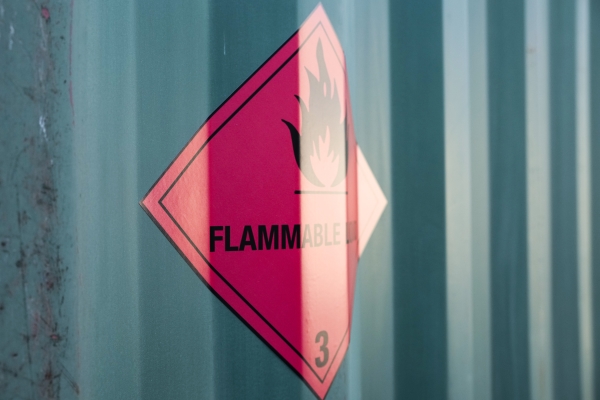
Materials and adhesive strength for the labelling of dangerous goods
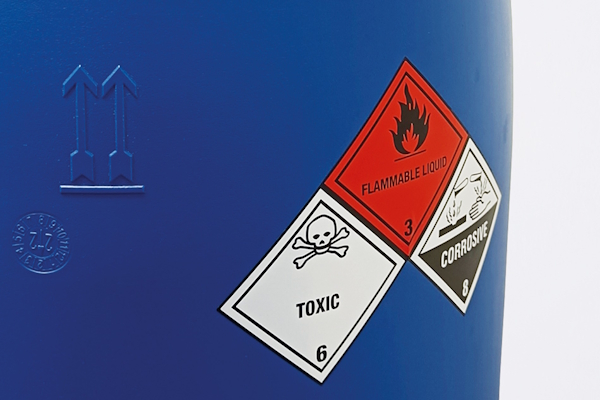
Dangerous goods labels must remain intact under conditions in which ordinary labels would have failed long ago. They are applied to steel and plastic drums, canisters, barrels, IBCs, big bags, bottles, containers and pallets – in other words, to metal, plastic, glass and wood, all of which have very different surface properties. According to ADR, the labels must remain clearly visible and legible throughout the entire journey and must withstand the elements without significant deterioration. The adhesive laminate, comprising film and adhesive, is specifically designed for this purpose.
- Chemical resistance: The labels resist acids, alkalis, solvents, grease and oil. This is crucial because product residues regularly come into contact with the outside of the containers during filling and handling.
- Temperature resistance: Depending on the material, the operating range extends from cold to hot; our white matt PE film, for example, withstands temperatures from minus 40 to plus 150 degrees Celsius. This also covers the hot-fill process for dangerous goods, where the label is applied to a container that is still warm.
- Weather and UV resistance: Dirt-repellent films and lightfast printing inks (Woll scale 6 to 7) ensure that pictograms and numerals remain legible even after prolonged outdoor storage.
- Adhesion to challenging substrates: Self-adhesive tapes with high initial tack and strong final adhesion hold firmly even on rough, curved or slightly soiled surfaces. Flexible films made from PE, PP and PET conform to curves and adhere just as reliably to shrink and stretch films.
- Seawater resistance: For sea and air transport, approval in accordance with the British standard BS 5609 is often required. Depending on the design, HERMA adhesive materials are certified in accordance with Sections 2 and 3; for placards, this also includes the individual imprint. For more detailed information, please visit our page on seawater-resistant labels.
The correct combination of film and adhesive depends on the container, the contents and the mode of transport. We work with you to develop the right solution, from material selection right through to the printing process.
An overview of the nine classes of dangerous goods
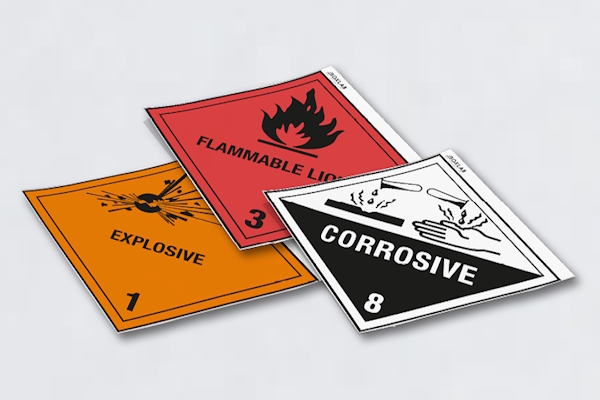
Dangerous goods are classified into nine classes according to their properties, several of which are further subdivided into subclasses. The class determines which hazard label must be affixed to the consignment and which large label must be affixed to the vehicle or container.
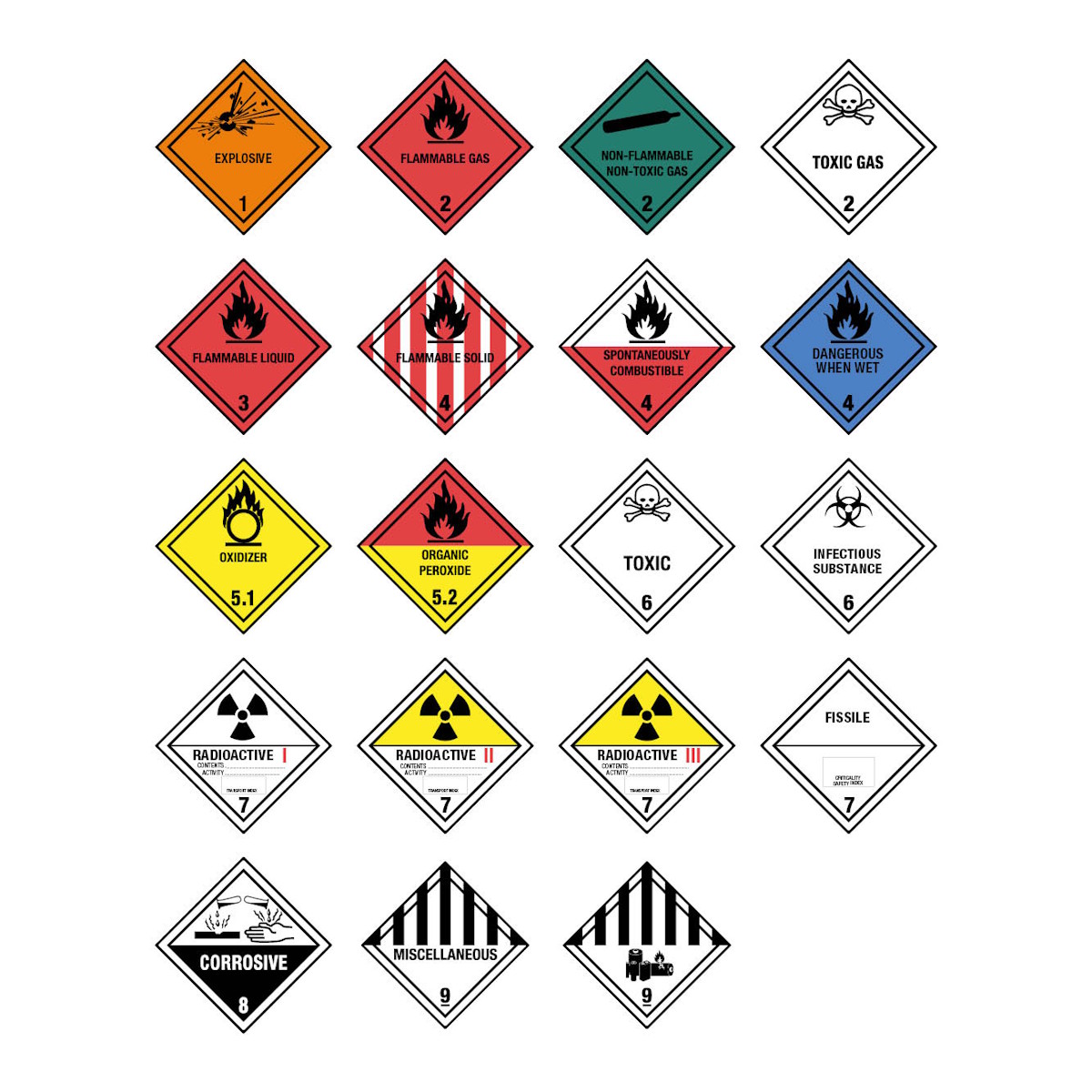
- Class 1: Explosive substances
- Class 2: Gases and gaseous substances
- Class 3: Liquid substances
- Class 4: Solid substances and objects
- Class 5: Flammable substances
- Class 6: Toxic substances
- Class 7: Radioactive substances
- Class 8: Corrosive substances
- Class 9: Miscellaneous dangerous substances
If a consignment contains several types of dangerous goods, several hazard labels must be affixed accordingly. In this case, two or three symbols can be combined on a single label, which makes the labelling process considerably easier. The symbols for all classes, as well as the permitted combinations, can be found under ‘Hazard Labels and Placards’.
UN number, Kemler number and other mandatory details
In addition to the hazard label itself, transport legislation requires further details to be displayed on the consignment and on the means of transport. Which details these are depends on what is being labelled.
On the consignment: Each consignment must be clearly and permanently marked with the UN number of the goods it contains, preceded by the letters ‘UN’. According to ADR, the character height must generally be at least 12 millimetres; reduced minimum heights apply to smaller containers. The UN number uniquely identifies the substance; for example, UN 1203 stands for petrol and UN 1789 for hydrochloric acid. Depending on the substance, this must also be accompanied by the official shipping name, orientation arrows for liquid goods and the symbol for environmentally hazardous substances.
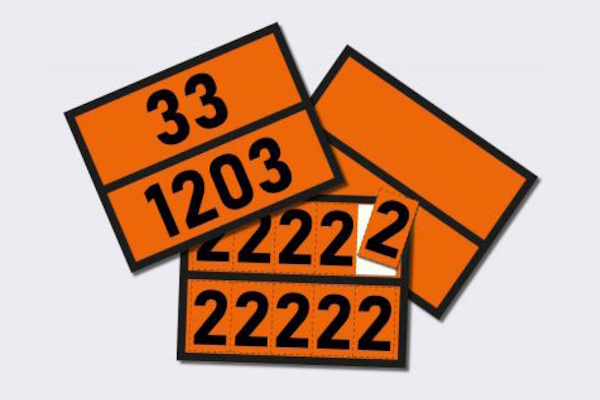
On the vehicle, container or tank: Here, large labels and the orange warning sign are affixed in place of, or alongside, the consignment marking. For tanks and tank containers, the warning sign displays the hazard number – also known as the Kemler number – in the upper panel and the UN number in the lower panel. The Kemler number describes the type of hazard using a combination of digits; a digit appearing twice indicates an increased level of hazard.
With warning signs from BOXLAB Services, you are on the safe side. Self-adhesive warning signs comply with the German technical regulations relating to the transport of dangerous goods by road and rail. They can be used on shipping containers, multiple-element gas containers, transportable tanks, vehicles and railway cars, to name a few examples. The self-adhesive warning signs are available in the standard format 400x300mm. They are equipped with a pull tab, which offers significant advantages in handling when sticking them on.
You can order your fully customised printed warning signs here: To the partnershop BOXLAB Services
Customised printing: As the UN number and hazard number are substance-specific, placards and warning signs cannot be fully pre-produced. Both are therefore available with customised printing, from as little as one unit. For placards, printing the UN number on the hazard label has been permitted since 2009; the certified print also meets the seawater resistance requirements of BS 5609 Section 3.
You can order custom-printed placards online here. Visit our partner shop BOXLAB Services
Printing dangerous goods labels yourself or purchasing them pre-printed
Whether you can print dangerous goods labels yourself depends on the type of labelling you require. The layout, colour scheme and dimensions of hazard labels and placards are legally prescribed. Designs, border lines and colour shades must be adhered to exactly, and the labels must remain visible and legible throughout the entire journey. Office printers and standard paper do not usually achieve this level of durability; deviating layouts will result in the consignment being rejected. It is therefore advisable to obtain these labels, which have been checked and pre-printed, from BOXLAB Services
The situation is different for labels that you would be filling in with your own details anyway: container and accompanying information, batch and product labelling, or additional notes on the consignment. For this purpose, HERMA offers blank sheet labels made from white PE film in common standard formats. These can also be used as hazardous substance labels on products. The material is weatherproof, oil- and dirt-repellent, temperature-resistant and adheres even to difficult surfaces. The labels can be printed on using laser and colour laser printers.
Frequently asked questions about dangerous goods labels

Request a quotation
If you would like to have dangerous goods labels printed in your own formats or with specific material requirements, we will produce them to your specifications. Please use the quotation form for this.