Transport labels that have no liner whatsoever - Linerless labels reduce waste and costs and protect the environment
Almost all packages have a large transport label. With HERMA InNo-Liner labels or classic linerless labels from HERMA, thousands of tons of backing (liner) material and their costly disposal can be saved every year.
Saving resources is becoming increasingly important. The EU Packaging Regulation (PPWR) sets out specific requirements for reducing packaging waste and conserving valuable resources. Labels play a key role in achieving these goals. Linerless labels from HERMA ensure that resources can be saved sustainably in the shipping sector and meet the requirements of the PPWR.
The overall climate-relevant carbon footprint is drastically reduced by using a linerless label.

Economic advantages
- Saving of disposal costs
- Reduced label price
- Lower transport costs
- Less space required for storage

Ecological benefits
- No backing paper material waste
- Lower material consumption
- Lower transport volume
- CO2 reduction

Application benefits
- Different label lengths
- Secure final adhesion
- Fewer roll changes
- Reduced downtimes
Ready for the future - with HERMA linerless labels
Linerless labels from HERMA are forward-looking, especially when you consider how global parcel volumes are developing. Parcel volumes have almost doubled between 2020 and 2025, to around 200 billion worldwide. Experts predict that the number of parcels shipped will grow by around 5-8% annually, driven primarily by the strong growth of online retail.
Avoiding backing paper contributes significantly to conserving valuable resources despite the increasing volume of parcels.
Contact us - we will be happy to advise you and work with you to find the optimum solution for your specific application.
NEW: Now also for
cab Print&Apply systems!
Curious? Read more

DHL relies on InNo-Liner solution from cab and HERMA
DHL: ‘This allows us to reduce waste by around 60 per cent, and it is around 40 per cent cheaper than conventional labelling systems.’
Read more in the latest news Play video
How do HERMA linerless labels differ from conventional self-adhesive labels?
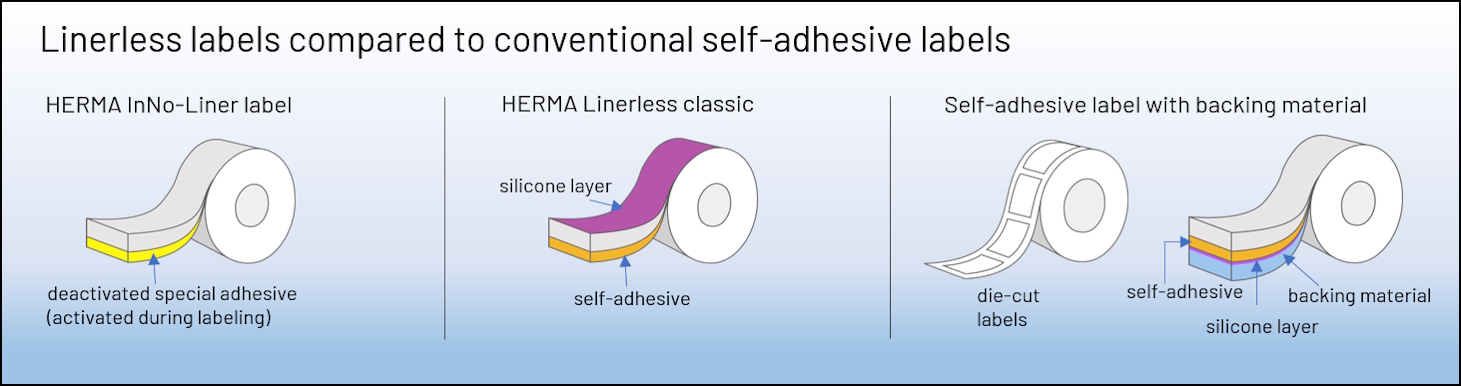
The decisive difference is: Linerless labels have NO backing paper. Conventional self-adhesive labels sit on a siliconized backing paper, and are already self-adhesive when they are detached from the underlay paper or the roll labels are dispensed by machine via a conventional labeling unit.
HERMA linerless labels do not use any backing paper at all. They are wound onto the roll themselves.
The width of the linerless labels on roll is determined by the width of the material. The label length is variable, and is defined by a cutting unit when labelling. Due to the lack of backing material, more labels fit on a roll, which in turn is easier to transport and takes up less space in the warehouse.
HERMA linerless labels are available in two different technical designs:

HERMA InNo-Liner labels
- Completely silicone-free
- Water-activated adhesive with very high final adhesion
- For thermal transfer printing and direct thermal printing with suitable print & apply systems
- Ideal for shipping cartons and other paper or cardboard surfaces
- Pre-printable in colour, e.g. with company logo
- Automatic dispensing
HERMA classic linerless labels
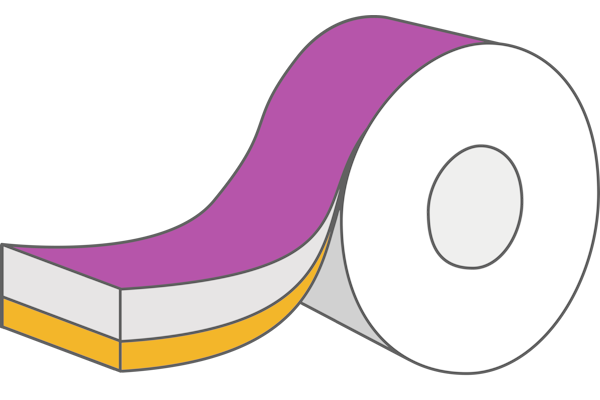
- Already self-adhesive, with silicone as a release layer
- High adhesive strength, good final adhesion
- For direct thermal printing with suitable print & apply systems and desktop devices
- Ideal for shipping cartons and other paper and cardboard surfaces
- Also ideal for foil surfaces
- Automatic dispensing or manual application
HERMA InNo-Liner labels
With the linerless labels from the HERMA InNo-Liner system, the label materials are also wound on roll, but they are not sticky because the adhesive is initially deactivated. This means that silicone can be completely dispensed with, which is the difference between these and classic linerless labels.
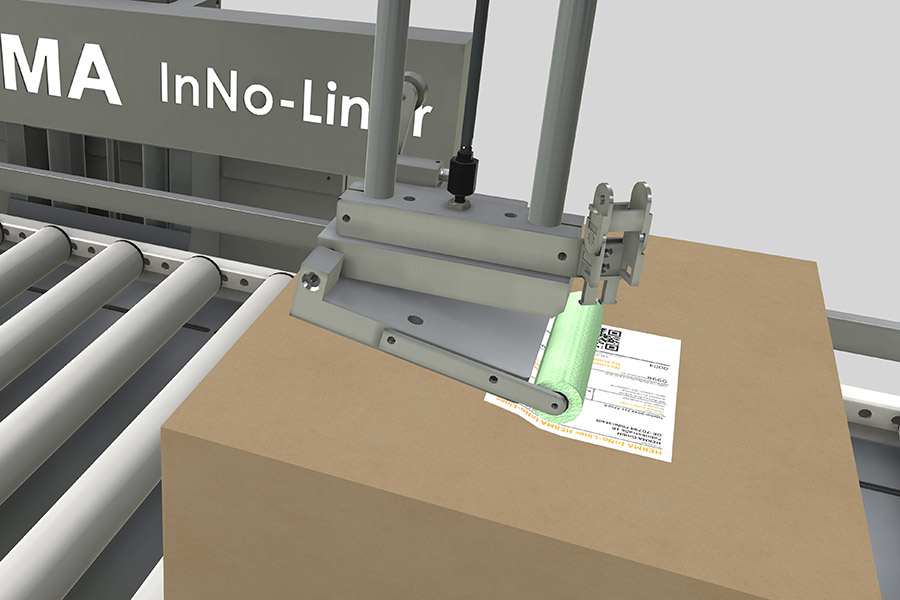
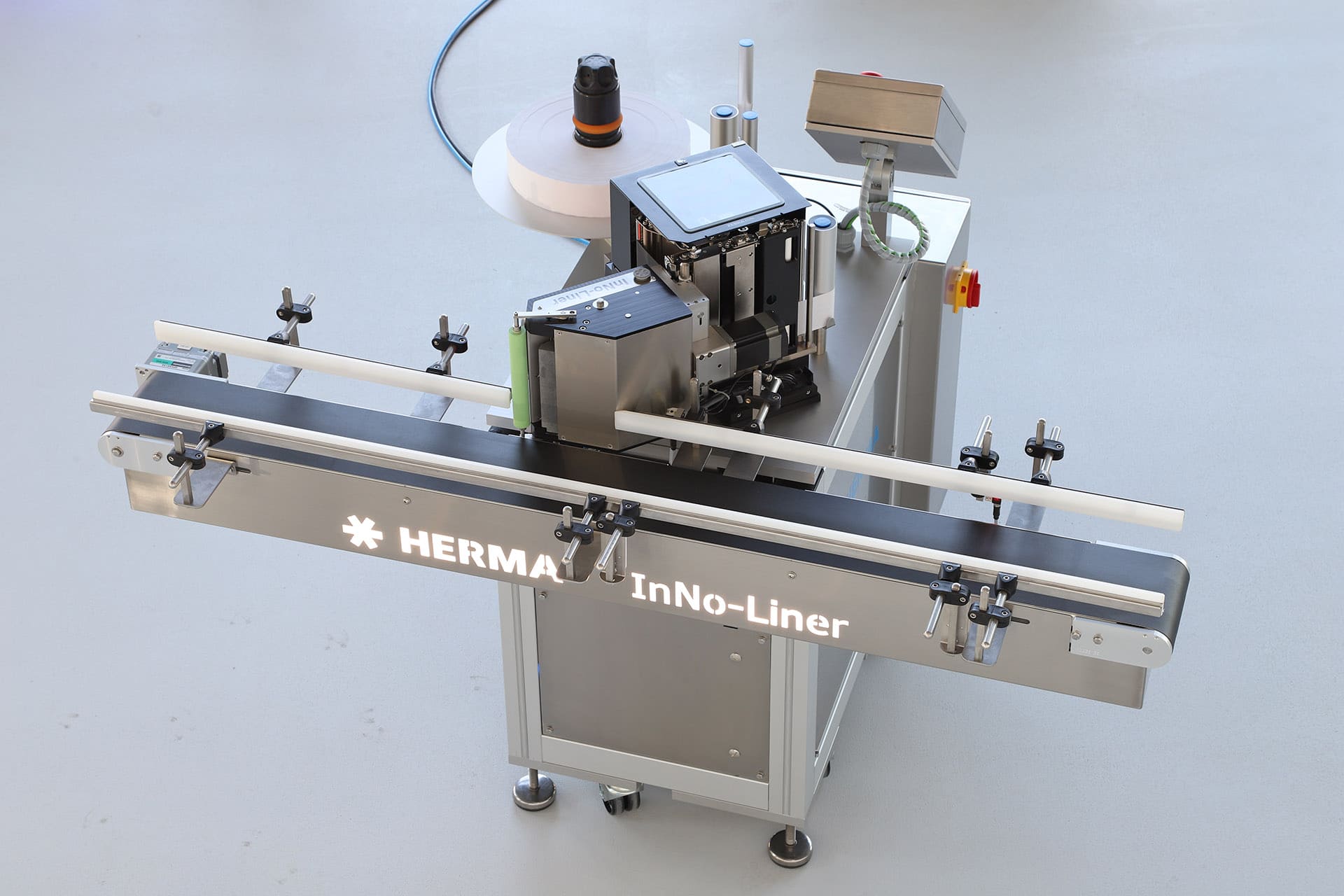
Only when labelling, a precise, purely water-based activation by the micro-atomization unit ensures that the linerless label becomes sticky and adheres – thanks to multi-layer technology for the adhesive immediately evenly and firmly on the surface. A very high final adhesion is achieved after a very short time. This requires a dispensing unit, which HERMA offers as part of the InNo-Liner system.
You can choose between thermal transfer label paper and direct thermal label paper, depending on the printing system in your packaging facility.
By not using silicone on the top of the label, HERMA can also pre-print in colour (e.g. company logo).
Water-based activation enables use on ‘absorbent’ surfaces, such as shipping cartons and other paper and cardboard surfaces. HERMA InNo-Liner labels cannot be used on foil packaging.
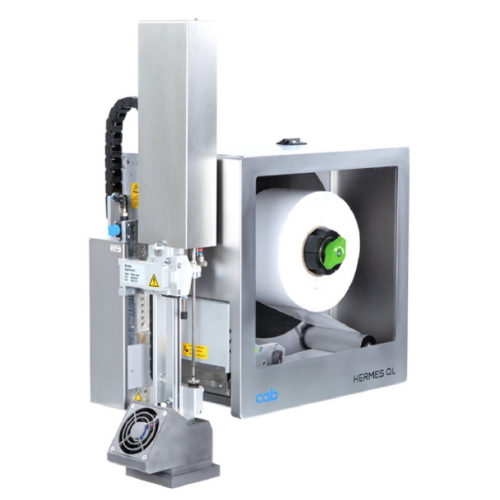
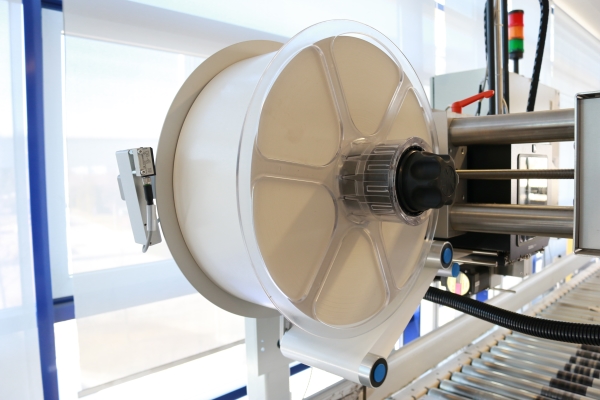
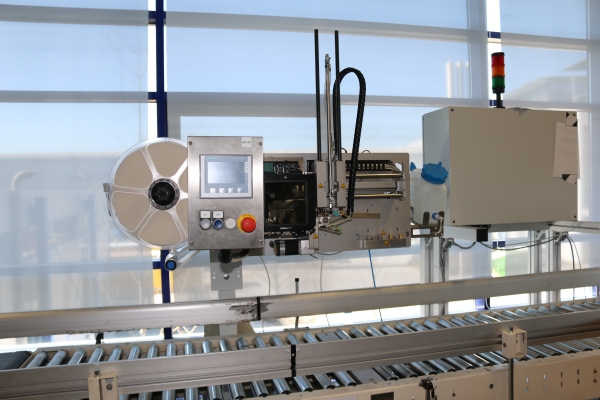
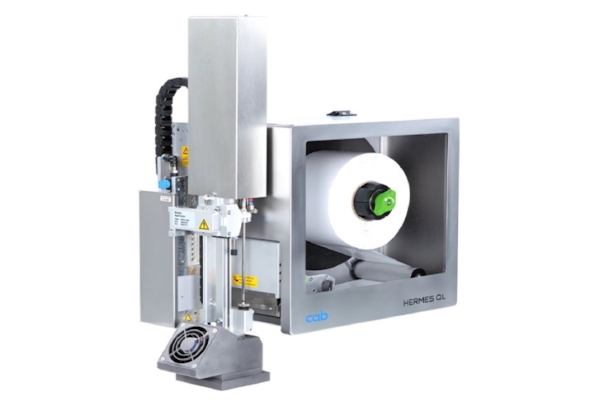
HERMA InNo-Liner labels can also be printed, activated and applied using print & apply systems from other manufacturers. In our cooperation with cab, the cab HERMES QL print & apply system has been innovatively further developed so that HERMA InNo-Liner labels can now also be printed and applied.
HERMA classic linerless labels
Classic linerless labels are self-adhesive and therefore require a silicone release layer on the top of the label so that the material can be wound onto itself and unwound during printing and dispensing.
The labels can only be printed on through the silicone layer on top, using direct thermal printing.
HERMA's two-layer adhesive technology has clear advantages over linerless materials from other suppliers:
- Water-based dispersion acrylate adhesive: no adhesive leakage, unlike hot melt
- Higher adhesive strength than most linerless products from competitors (hot melt)
- Full-surface adhesive application without non-adhesive areas at the sides: full-surface adhesion to cardboard or other surfaces
Classic linerless labels adhere firmly and securely to many different surfaces, from film to cardboard. This allows them to be used in many logistics applications, not just on shipping cartons.
Classic linerless labels can be used in automated packaging processes or printed with suitable tabletop devices and then applied by hand. The width of the linerless label roll can be freely defined from 50-150 mm. This makes it possible to retain the dimensions of the self-adhesive labels used previously without any conversion effort, e.g. in the printing software.
NEW: Cooperation cab and HERMA
Both HERMA InNo-Liner labels and classic linerless labels from HERMA can be printed and dispensed using the cab HERMES QL.
As one of the leading manufacturers of label printers and labelling systems, cab now offers the new HERMES QL labelling system, which can print and apply HERMA InNo-Liner labels in addition to classic linerless labels. It offers an attractive price/performance ratio, compact design and short delivery times.
The new cab HERMES QL linerless printing and labelling system processes HERMA InNo-Liner labels using direct thermal printing. On request, the system can also be provided for HERMA InNoLiner themotransfer labels.
Classic linerless labels from HERMA can also be printed using cab's print&apply systems with direct thermal printing.
Our partner cab will be happy to advise you on which Print&Apply system from the HERMES QL series is right for your application!
Find out more about the cab HERMA QL with HERMA InNo-Liner / Contact cab
Saving material without generating additional costs?
Read more in the interview with Clement Kleinclauss, Managing Director of cab in France.
DHL adopts InNo-Liner solution from cab and HERMA
Shipping labels without liner material or silicone coating offer a sustainability advantage that has also convinced a leading logistics provider like DHL. At its site in Nohra, Thuringia, Germany, the company has now switched from conventional self-adhesive labels to a joint InNo-Liner solution from cab and HERMA.
“It enables us to reduce waste by roughly 60 percent, simply because the silicone-coated liner is eliminated and we gain flexibility in label sizes,” says Aiste Slabokaite Heid, Business Unit Director North-East DHL Supply Chain Germany & Alps. “The system also helps us cut costs: It is about 40 percent more economical than conventional labeling systems.”
Linerless labels HERMA InNo-Liner: ideal for shipping labels
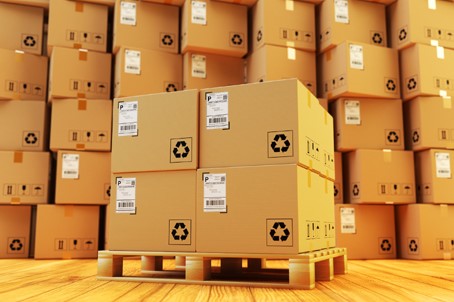
A transport box without a shipping label - unimaginable. This is because shipping labels ensure that the parcel reaches the right recipient safely.
131 billion parcels per year: This value is given by the "Parcel Shipping Index" for 2020 – for 13 major "shipping nations" such as Germany, England, France, Italy, the USA, China and Japan alone. In Germany alone, more than 13 million logistics labels are used on transport cartons every day (source: Bundesverband Paket und Expresslogistik (BIEK).
Considerable savings potential, with secure adhesion even at high cycle rates
Considerable figures - and considerable savings potential with HERMA InNo-Liner labels, which, in conjunction with the HERMA InNo-Liner labelling system or the cab HERMES QL labelling system, meet the cycle rates and requirements of shipping and logistics centres.
Extremely important for shipping labels is the secure adhesion to the often rough and dusty cardboard surfaces. The multi-layer technology of the HERMA InNo-Liner adhesive ensures that the linerless labels adhere securely and firmly immediately after labelling - permanently!
How does labelling variable carton heights work with the HERMA InNo-Liner system?
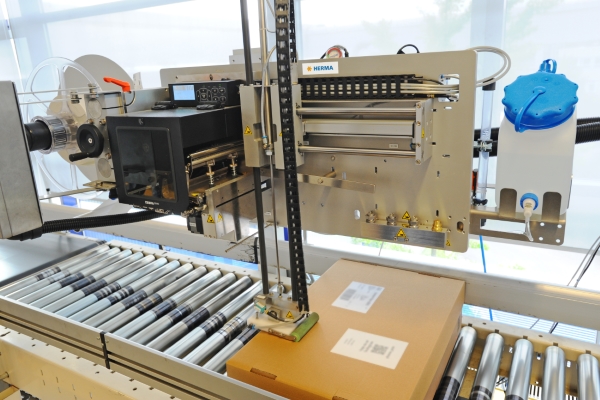
The linerless HERMA InNo-Liner system can now also label variably-fed transport cartons, i.e. cartons of different sizes, in any order, either on the side or on the top of the carton, with linerless labels. The non-adhesive linerless label with the inactive adhesive is transferred to a vacuum suction plate, which is equipped with a linear unit and a sensor to determine the carton height. The water-based activation unit then activates the adhesive with a micro-fine, extremely even spray mist. The linear unit then automatically moves the vacuum suction plate with the activated linerless label to the labelling height required for that particular package, with the adhesive side facing the cardboard.
Linerless labels: more cost-effective than a conventional self-adhesive shipping label
When used in conjunction with the HERMA InNo-Liner system or the cab HERMES QL printing and labelling system, HERMA InNo-Liner linerless labels easily achieve the cycle times typically required for labelling shipping cartons. And the costs for the linerless labels are lower than for a conventional self-adhesive label. The decisive advantage of the linerless label without liner: the costs for disposing of the liner or backing material are eliminated completely. Plus: the elimination of the backing paper reduces the storage costs for the labels, because there are about 50% more labels on the roll for the same roll size.
CO2 savings with HERMA Linerless labels
With an annual volume of 2 million shipping labels in the common format 105x148 mm (A6), the use of conventional self-adhesive labels results in a carrier paper area of approx. 32,700 m², which corresponds to an area of more than 4 foot panels. The weight of the carrier material is about 1.8 tons. When using linerless labels, this carrier material is completely omitted.
By eliminating the carrier paper, the CO2 footprint is reduced by 1.89 tons of CO2. This already means 45% less CO2 emissions compared to the classic self-adhesive label.
Further CO2 savings are achieved by eliminating matrix waste in the production of classic self-adhesive labels. This results in a further CO2 saving of approx. 12% (with roll width 333 mm). Due to lower warehousing and handling costs, further savings of approx. 3 percent can be achieved. Together, this is about 60% total CO2 savings with HERMA InNo-Liner or classic linerless labels - compared to a classic self-adhesive label.
In this example, the savings in the disposal of the carrier paper are about 180 euros per year. Based on 1000 labels, this is 0.09 Euro/1000.

Calculator for determining the CO2 savings with HERMA InNo-Liner
Quickly and easily determine your possible CO2 savings if you rely on linerless labels without carrier material instead of self-adhesive labels with carrier material.
How do the variable data get on the linerless label?
Both HERMA linerless label systems are wound onto themselves – but they differ in terms of printing options.
HERMA InNo-Liner: variable printing, with thermal transfer or direct thermal printing
The linerless labels in HERMA InNo-Liner technology are wound onto the roll ‘on themselves’. Thanks to the special deactivated adhesive, they do not stick to themselves – and no silicone is required on the label surface to prevent sticking – an advantage over classic linerless systems.
By dispensing with silicone as a separating layer, HERMA InNo-Liner label rolls can be pre-printed in one or more colours using conventional printing processes at HERMA, for example with your company logo in your corporate colours or shipping instructions that you want to make particularly noticeable.
Only when the linerless labels are dispensed with a HERMA InNo-Liner dispenser or the cab HERMES QL labelling system does a precise, purely water-based activation ensure that the HERMA InnNo-Liner linerless label becomes tacky. The adhesive with multi-layer technology ensures uniform and immediately very strong adhesion to the surface.
Linerless labels are printed directly with the variable data in the HERMA labeling unit before they are self-adhesive activated and dispensed (Print&Apply). You can choose between thermal transfer printing and direct thermal printing. The HERMA InNo-Liner system is also comparable to other Print&Apply systems in terms of printing and dispensing speed.
HERMA Linerless Classic: variable printing with direct thermal printing
Due to the silicone release layer on the top of the label, the labels can only be printed using direct thermal printing. The colour change in the thermosensitive layer is not affected by the silicone layer. As with self-adhesive thermal labels, no additional ink ribbons are required for linerless thermal labels.
In later use, the silicone layer provides protection against moisture and other environmental influences – a clear advantage over conventional self-adhesive thermal eco labels.
With the cab HERMES QL Linerless printing and labelling system, classic linerless labels from HERMA are printed and dispensed using direct thermal printing. This linerless label quality is suitable for use in shipping, on cardboard or foil, and can be printed at high speeds. The thermal linerless labels are also approved for use in the food industry.
The following linerless label materials are currently available:
HERMA InNo-Liner for thermal transfer printing
- Paper, white, satin finish
- Non-adhesive, water-activated adhesive
HERMA InNo-Liner for direct thermal printing
- Thermal paper ECO, BPA-free, white (without protective coating)
- Non-adhesive, water-activated adhesive
HERMA Linerless classic for direct thermal printing
- Thermal paper TOP, BPA-free, white (with protective coating)
- Self-adhesive, with silicone as a release layer
Variable label width and roll length
We produce your HERMA Linerless label rolls in the desired width, from 50 mm to 150 mm, to suit your printing system. The roll length is variable from 100 metres to 1400 metres. The rolls can be produced with different core diameters, from 1 inch (25.4 mm) to 3 inches (76.2 mm), to suit your print & apply system or desktop printer for classic linerless labels.
HERMA InNo-Liner labels can also be pre-printed in multiple colours, e.g. with your company logo. This is not possible with classic self-adhesive linerless labels.
Frequently asked questions about linerless labels
Learn more about the components and the complete solution HERMA InNo-Liner
With a unique, end-to-end chain of know-how: from adhesive material to labels to high-performance labellers, all three business units have jointly developed the InNo-Liner system - with full commitment to innovation and sustainability in packaging and logistics processes.
Learn more about the technical details of the adhesive material and Print&Apply system - and contact us - we will be happy to advise you and work with you to develop the optimal solution for your specific application.

Please use this contact form for inquiries about industrial requirements.
If you have any questions about HERMA branded products in smaller packaging units, we look forward to your inquiry using the contact form "Office and Home".
Request a quotation
We produce labels according to your specifications - to suit your industrial application!

Please take a moment to give us some detailed information on the following page so that we can advise you well.
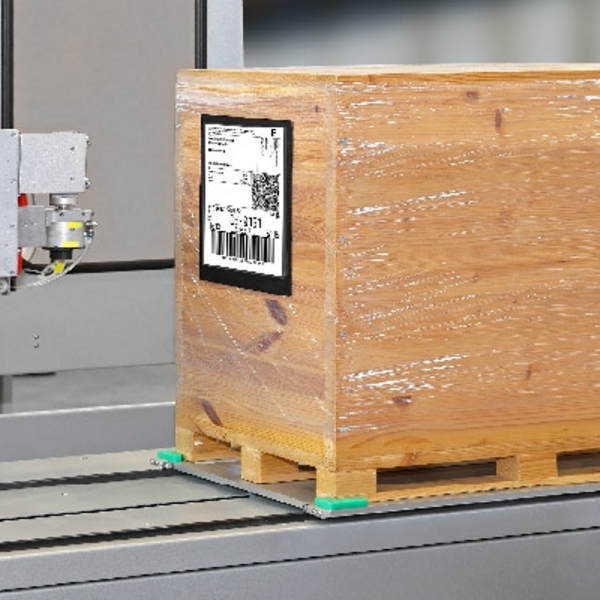
Self-adhesive shipping labels - ideal for all surfaces
For many surfaces in the logistics sector, classic self-adhesive labels are the optimal solution, e.g.
- Transport labels on shrunken pallets (stretch films)
- Shipping labels on uneven surfaces (e.B. containers)
- Pallet foot labels (rough wood surface)
- and of course also for shipping boxes that are labeled with other systems
Learn more about HERMA transport labels and pallet labels