


HERMA produces labels for the labelling of hazardous substances that adhere securely even under difficult conditions: on drums, barrels, canisters, containers, IBCs, big bags and bottles made of metal, plastic, glass or wood. Hazardous substances are handled in a wide range of sectors, for example in the chemical industry, the construction sector, metalworking, the healthcare sector and the cosmetics industry. Hazard labels and stickers for CLP-compliant labelling make an important contribution to health and safety in the workplace.
HERMA hazard labels: pre-printed or blank
There are two ways to label hazardous substances, and which is the right one depends on your print run and the printers you have available.
Pre-printed labels with GHS diamonds
For larger orders, we produce your customised labels for the labelling of hazardous substances, pre-printed with one or more red diamonds, into which you can subsequently print the relevant pictograms and further information about the hazardous substance in black using a laser printer (sheet labels) or a thermal transfer printer or colour inkjet printer (roll labels). This saves on toner or ink.
Blank labels for self-printing
In our online shop, we offer suitable standard formats as blank labels made from PE laser material for the labelling of hazardous substances.
This allows you to produce small batches of labels for hazardous substance labelling entirely yourself using a colour laser printer.
Print your own hazardous substance labels – order online now
Printing your own hazardous substance labels is possible and, for many businesses, the most practical option. Unlike transport hazard labels, there are no prescribed designs for GHS labelling that need to be purchased ready-made. The content, minimum size and legibility are prescribed, but you design the label yourself, as the product name, batch number, and H and P statements vary from substance to substance.
The material is therefore more important than the imprint. A hazardous substance label made from ordinary paper will not withstand contact with chemicals, moisture or UV exposure, and an illegible label no longer meets the requirements of the CLP Regulation. For in-house printing, we therefore offer blank labels made from white PE film in common standard formats, suitable for printing with laser and colour laser printers.


Why labels are needed for the labelling of hazardous substances
The labelling of hazardous substances serves to highlight toxic and harmful substances. Strict legal regulations apply to the labelling of hazardous substances on products. The GHS/CLP Regulations stipulate that toxic and harmful substances must be labelled in a uniform manner worldwide. This is intended to improve safety when working with hazardous substances in the long term. GHS stands for the ‘Globally Harmonised System of Classification and Labelling of Chemicals’. CLP stands for ‘Classification, Labelling and Packaging of Substances and Mixtures’. The supplier is obliged to label products and hazardous substances in accordance with these guidelines.
When placing products on the market, the CLP Regulation (EC) No 1272/2008 applies, which is directly applicable in all EU Member States. For activities carried out on site – namely storage, decanting and use – the German Hazardous Substances Ordinance (GefStoffV) also applies. Its definition of a hazardous substance is broader than the labelling requirements under CLP, as it also covers substances that are only produced during the course of such activities.
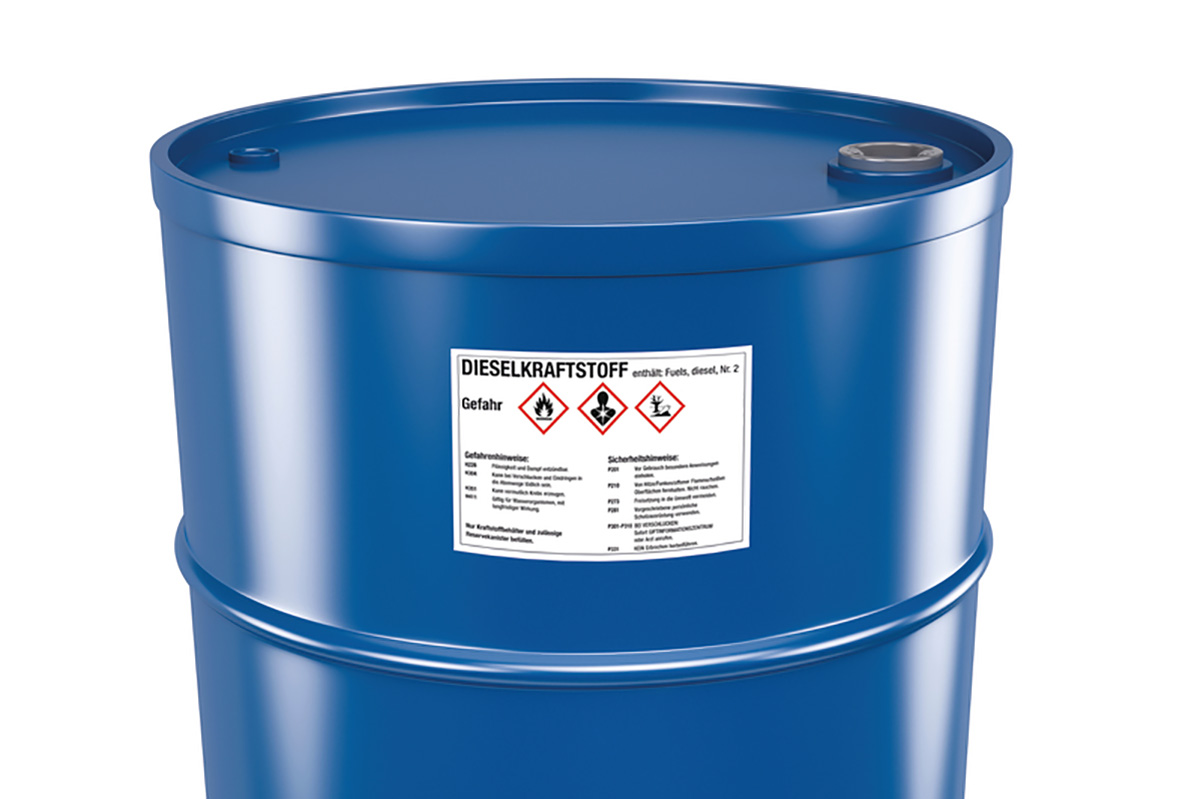
What are hazardous substances?
Substances and preparations (products or mixtures) that exhibit one or more hazard characteristics are referred to as hazardous substances (within the meaning of the Hazardous Substances Ordinance, GefStoffV). These hazard characteristics are referred to as ‘hazard classes’ in the CLP Regulation. Classification into hazard classes further specifies the hazardous properties of a substance, such as the risk to health or the risk of explosion. Additional hazard categories describe the severity of the risk posed by the chemical.
Hazardous substances may, for example, be explosive, corrosive, toxic, oxidising, self-reactive, infectious, carcinogenic or harmful to the environment. Examples include motor vehicle fuels such as petrol and diesel, acids, propane gas, cleaning products, solvents, volatile gases, poisons such as arsenic, as well as fireworks and lithium batteries.
Labels for the labelling of hazardous substances have a wide range of applications: According to the GHS/CLP Regulation, every container or receptacle in which hazardous substances are kept, stored or transported must be labelled in accordance with the relevant standards. This means that the contents of every chemical container in a laboratory, every canister in a workshop or production facility, and even heating oil tanks and petrol pumps at service stations must be clearly declared using hazardous substance labels.
What are the four objectives of the GHS?
The Globally Harmonised System was developed by the United Nations to standardise the previously very diverse national labelling systems. It has four objectives:
1. Improve the protection of people and the environment. Standardised labelling helps workers, consumers and emergency services to understand risks more quickly and respond appropriately.
2. Communicate hazards consistently worldwide. Through standardised pictograms, signal words and hazard statements, chemical hazards are presented according to the same rules everywhere.
3. Facilitating trade in chemicals. A uniform system reduces the need for differing national labelling regulations. Companies can trade in chemicals internationally without having to label them separately for each country.
4. Avoid duplicate testing and assessments. Consistent classification criteria ensure that hazard assessments are comparable worldwide and that substances do not have to be tested repeatedly against different standards.
For you, as a distributor, this means that a label designed in accordance with CLP is valid in all EU Member States, and the pictograms are also understood outside Europe.
What information a hazardous substance label must contain
Labels for hazardous substances must contain information on ingredients, as well as potential hazards and classification, in the form of prescribed pictograms (hazard symbols). These labelling elements provide guidance to people handling a hazardous substance regarding the associated risks. To ensure that the nature and severity of the hazard can be recognised quickly, hazard pictograms, signal words and hazard or precautionary statements are displayed on the GHS label.
A standard-compliant hazardous substance label contains:
- Product identifier: name of the substance or mixture
- Hazard pictogram: red diamond with a black symbol on a white background
- Signal word: DANGER for high risk, WARNING for lower risk
- Hazard statements (H-phrases): describe the specific hazard, for example H225: Liquid and vapour are highly flammable
- Precautionary statements (P-phrases): provide recommendations for safe handling, for example P280: Wear protective gloves and eye protection
- Supplier details: Name, address and telephone number of the manufacturer or distributor
- Nominal quantity: for products intended for the general public, unless the quantity is stated elsewhere on the packaging
- Supplementary information: EUH phrases and other mandatory information in accordance with Article 25, where applicable

The hazard symbols set out in the CLP Regulation are designed to draw attention to a hazard through their shape and colour. They consist of a black symbol on a white background within a red diamond, also known as a GHS diamond. This significantly reduces the risk associated with the use, transport, production or storage of hazardous substances. A product may well require several hazard symbols on its label because it exhibits different hazard characteristics.
The extensive text of the hazard statements presents a particular challenge. As space on GHS labels is limited, this information often has to be printed in very small type. To ensure the text remains clearly legible, high-quality label material is required that enables sharp, well-defined print results and optimum contrast.
How large a label for the labelling of hazardous substances must be
The minimum size of the label depends on the capacity of the packaging. The requirements are set out in Annex I, Section 1.2.1 of the CLP Regulation and specify not only the label size but also the minimum dimensions of the hazard pictograms.
In addition, each hazard pictogram must cover at least one fifteenth of the area of the labelling label; the minimum area is 1 cm². For packaging up to 3 litres, the pictograms should, where possible, measure at least 16 x 16 mm, but under no circumstances less than 10 x 10 mm.
With the revision of the CLP Regulation, fixed minimum dimensions for each pictogram, as well as requirements for minimum font size, will come into force from 1 January 2028. Anyone planning label formats for the long term should already be aware of these values.
HERMA wrap-around labels for chemical products are the ideal way to comply with the stricter labelling requirements of the new CLP Regulation for chemical products. Discover the benefits of HERMA wrap-around labels for chemical products
Hazardous substance labels or dangerous goods labels: what is the difference?
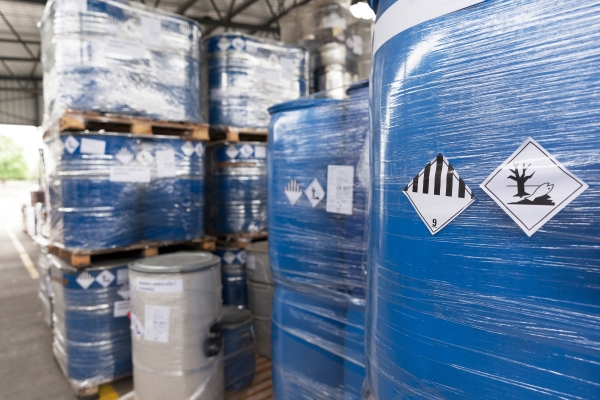
The term ‘hazardous substance’ is often used interchangeably with ‘dangerous goods’, but the two are not the same. Hazardous substances are all substances, articles and goods which pose a hazard when used or stored, and are harmful to human health and the environment, not only during transport. If objects or a substance pose a further hazard during transport, they are classified as dangerous goods and must be labelled as such. As a rule of thumb: a hazardous substance becomes a dangerous good as soon as it leaves the premises and is transported.
Entsprechend unterscheiden sich auch die Gefahrenetiketten:
Label for hazardous substances

- Low level of standardisation; various formats and materials
- Blank labels or pre-printed red diamonds; specific information is printed by the user
- Usually custom-made
Label for dangerous goods

- Standardised appearance; diamond featuring the hazardous goods symbol in both image and text
- Fully printed; in the case of placards, sometimes individually printed with the UN number
- Layouts and sizes prescribed by law; important for legal certainty
In practice, both types of labelling are often found on the same container; they are both applied to the same surfaces, withstand the same chemicals and must be compliant with BS 5609 for sea transport. You can therefore use the same material grade for both applications.
You can find everything you need to know about transport labelling on our page on dangerous goods labels
Materials and adhesion of labels for hazardous substances
Labelling of hazardous substances often takes place in the chemical industry, and the hazardous substance labels must adhere securely to a wide variety of containers. These may include drums, barrels, canisters, containers, IBCs, big bags and bottles. Surfaces made of metal, plastic, glass and wood present a wide range of challenges. Depending on the intended use, resistance to chemicals (acids, alkalis, solvents), dirt, grease and oil, as well as environmental factors such as heat, humidity, cold and UV exposure – right through to resistance to seawater – is required. This can be achieved particularly effectively using specialised film labels.
HERMA labels for hazardous substance labelling are characterised by robust yet flexible films with specific properties, and adhesives with a wide temperature range and suitability for use on various surfaces. They easily comply with additional requirements like resistance to filling with hot liquids. Lightfast inks (Woll scale 6 to 7) ensure the GHS diamonds remain clearly visible over time. Paper labels can be used for the labelling of hazardous substances on cardboard packaging or plastic films, particularly for internal transport.
Features of HERMA hazardous substance labels
- Reliable adhesion to a wide variety of containers, including those with soiled surfaces
- Saltwater-resistant as per BS 5609/II
- Weatherproof, oil- and dirt-repellent
- Temperature-resistant from -40° C to +150° C
- Flexible and stretchable, ideal for curved surfaces
- Pre-printed GHS diamonds made of light-resistant printing inks (Blue Wool Scale 6-7) for long-lasting visibility
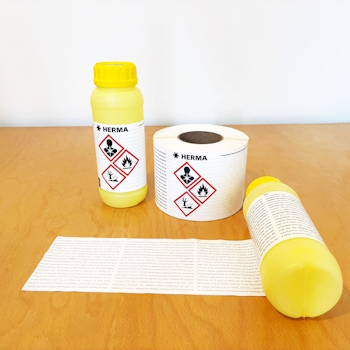
- Easy overprinting with laser printer (sheets) or thermal transfer printer / colour inkjet printer (rolls)
- Label format and die-cutting according to your specifications
Seawater resistance in accordance with BS 5609
When chemical drums are transported by sea, seawater certification is also required. HERMA labels for hazardous substances, made from PE laser material, are seawater-certified in accordance with the British Standard 5609. Depending on the required section, we can produce labels for you using a wide range of adhesive materials, including those compliant with BS 5609 Section 3. Find out more on our page about seawater-resistant labels.
Pre-printed GHS diamonds for overprinting with your label printer
HERMA’s film labels, produced using our own adhesive materials, provide the best basis for your chemical labels and hazardous substance labels. Pre-printed labels with GHS diamonds in your chosen label format are ideal for customised overprinting using your own printer. We manufacture hazardous substance labels in accordance with GHS in every standard roll and sheet format.
Depending on your printer type, we can produce the following for you:
On a roll for thermal transfer printers
For thermal transfer printing, we produce hazardous substance labels on rolls made from a variety of adhesive materials. They can be applied not only by hand but also using labelling machines, even at high labelling speeds. Our special die-cutting technique reliably prevents contamination of the thermal transfer printer and the labelling machine, despite the heavy application of adhesive on the hazardous substance label – which is particularly important for secure adhesion.
Find out more about seawater-resistant thermal transfer labels
On a roll for inkjet printers with pigmented inks
Inkjet printers for roll labels enable variable printing, hazard symbols in colour and a variety of text. This means that HERMA materials can be used to produce seawater-resistant inkjet labels with high colour brilliance and print quality. Thanks to the special surface coating on the film labels, the print is smudge-proof and water-resistant.
The adhesive is temperature-resistant and adheres reliably even to difficult surfaces.
Find out more about seawater-resistant inkjet labels
On A4 or A3 sheets as well as in special formats for black & white and colour laser printers
HERMA’s BS-5609-certified film labels are the ideal solution for small print runs with variable data. The special laser-printing material is characterised by excellent toner adhesion and high reliability during processing. All film materials for hazardous substance labels meet the strict requirements of the British Standard.
Find out more about seawater-resistant laser-print labels

Request a quotation
We produce labels according to your specifications - to suit your application!
Please take a moment to give us some detailed information on the following page so that we can advise you well.
Frequently asked questions about hazardous substance labels
Solutions for hazardous substance labels - from us to you
Discover practical uses for dangerous goods and hazardous substance labels
Labels for hazardous substances must adhere securely to a wide variety of containers – and they often have to be saltwater-resistant. Discover a practical use for GHS labels.
Our ‘Solutions’ section has many more examples of label usage for a wide range of industries and requirements.
Seawater-resistant labelling using GHS labels for metal drums and chemical containers
Track & trace in the chemical industry with chemical container labels
More information about chemical labels

CLP labelling: wrap-around labels for chemical products
HERMA's wrap-around labels are the ideal way to comply with the stricter labelling requirements of the new CLP Regulation for chemical products. Printable on both sides, ideal for multiple languages. Secure adhesion to all containers, machine-applicable, variable data can be printed on the outside. The flexible film material is chemical-resistant and seawater-certified. The label can be easily opened with the integrated tab, and the special adhesive allows the layers to be unwound easily.
Learn more about the advantages of HERMA wrap-around labels for chemical products
Comprehensive expertise for labelling your dangerous goods.
HERMA and BOXLAB Services have concluded a cooperative agreement for labelling dangerous goods. Even small quantities can be delivered quickly and in high quality - legally compliant and in conformity with standards.
Discover your advantages and detailed information on hazard labels, warning plates and
placards