


GHS labels: safe labelling in accordance with the Globally Harmonised System
Be on the safe side with HERMA labels based on the GHS
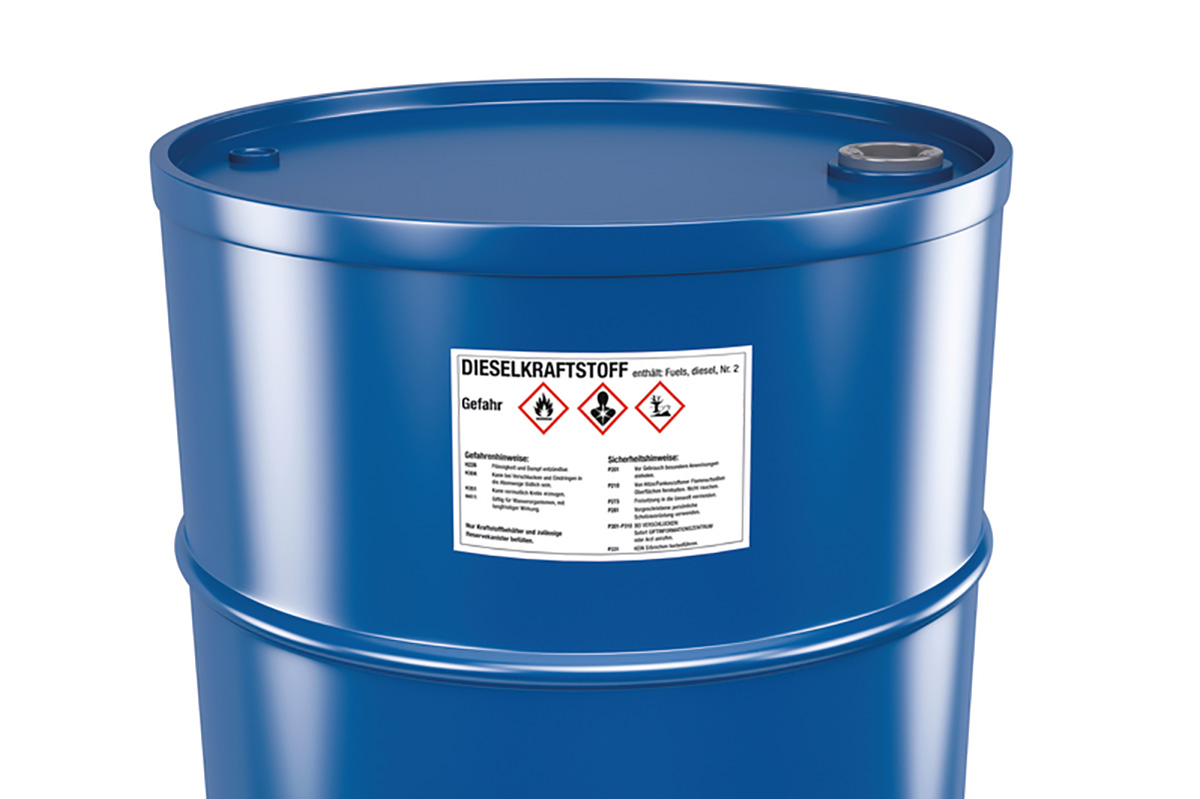
The usage scenario: labelling metal drums for overseas transport using hard-wearing GHS labels
Legal labelling requirements for chemicals under the GHS
Product and chemicals labelling in the chemical industry is subject to very strict legal regulations. The GHS regulation (CLP regulation) prescribes globally uniform guidelines as a system for the classification and identification of chemical substances. The purpose of GHS labelling is to protect people and the environment. An example is health hazards such as eye injuries.
GHS stands for Globally Harmonized System of Classification and Labelling of Chemicals (also called GHS labelling system or Globally harmonised system of chemical labelling). CLP stands for Classification, Labelling and Packaging of Substances and Mixtures. The GHS divides dangerous substances into classes represented by different hazard symbols (GHS labels pictograms). These classes are based on the properties of substances and mixtures. Examples are explosive, flammable, corrosive, oxidising and environmentally harmful.
Content and structure of labels in accordance with GHS
In addition to the typical red diamonds featuring the corresponding black hazard pictograms, GHS labels contain further important information. This includes the product identifier (name of the substance), a signal word, and hazard statements detailing the health risks posed by the substance.
Furthermore, the labels provide information on the ways in which the substance poses a risk to the environment, as well as safety instructions on the measures to be taken in the event of contact.
High standards for legibility and print quality in GHS labels
The extensive text of the hazard statements presents a particular challenge. As space on GHS labels is limited, this information often has to be printed in very small type.
To ensure that the text remains clearly legible, high-quality label material is required that delivers sharp, crisp print results and optimal contrast.
GHS chemical drum labels with information on ingredients, real or potential hazards and classification must adhere securely to a wide variety of containers. Metal drums and metal containers are frequently used again and again.
Extreme environmental conditions during storage and transport
Containers holding hazardous substances are stored both indoors and outdoors, and are often exposed to significant temperature fluctuations and moisture. In addition, UV radiation causes considerable wear and tear, which is why the printing inks must have a particularly high level of lightfastness.
Furthermore, the coated surfaces of the containers are often contaminated with grease, oil or dust.
Chemical exposure and difficult surfaces
The contents of the drums are often filled whilst still hot. Furthermore, acids, alkalis or solvents may come into contact with the surface of the metal drums.
This places particularly high demands on the adhesive used on the labels. It must adhere securely, immediately and permanently, even under extreme conditions. Environmental factors such as heat, humidity, cold and UV radiation place additional strain on the GHS labels.
In addition to metal containers, PE drums, canisters and IBC containers are also used. These often have curved and, in some cases, rough surfaces. For such applications, a label material that is both particularly flexible and very robust is required to ensure that the labelling adheres securely and permanently.
BS 5609: Labels for the transport of dangerous goods by sea
A special approval is also required for the labelling of dangerous goods during transport by sea. In this context, certification to the British standard BS 5609 is often required, as it ensures the durability and adhesion of labels under maritime conditions.
The solution: GHS labels, made of PE film for laser printers and copiers
Our sheet labels made of white matt PE film or PET film with extremely strong adhesive meet the particularly high chemical label requirements of the GHS labels application and are ideal for printing hazard / safety information on all laser printers and colour laser printers.
GHS labels: Saltwater-resistant as per BS 5609
The British Standard BS 5609 stipulates that the labels on hazardous substances and dangerous goods (GHS labels) must be able to be stored in saltwater for three months without becoming detached from the container. For sea and air freight, the law says that only packaging and containers with certified, saltwater-resistant, hazardous goods labels and hazardous substance labels should be transported. Drawing from our wide range of adhesive material, we can manufacture ready-to-use GHS labels that comply with the section of BS 5609, including Section 3.
One example is our material for single sheet usage, made of white matt PE film with an extremely strong adhesive, ideal for GHS labels::
- Weather-resistant, oil- and dirt-repellent
- Temperature-resistant from -40° C to +150° C
- Very flexible and stretchable, ideal for curved surfaces
- Excellent adhesion, even on dirty surfaces
- Excellent results on black & white and colour laser printers
Learn more about Seawater-proof, laserprint labels
GHS labels for individual re-printing with your printer
Other film labels from our in-house adhesive material production are also ideally suited for labels GHS. Pre-printed labels with GHS diamond frames in your label format are suitable for individual re-printing with your printer. Here high-quality printing results are essential on account of the small fonts often used for precautionary statements. According to the Blue Wool Scale, the coloured printing inks used for pre-printed red diamond frames have a lightfastness of 6-7. These labels for chemicals are also highly resistant to environmental conditions and have excellent adhesion. Depending on the type of printer, we will produce GHS labels for you in your desired format:
- On a roll for thermal transfer printers
- On a roll for inkjet printers with pigmented inks
- On A4 or A3 sheets as well as in special formats for black & white and colour laser printers
Seawater certification plus removability from re-usable containers
Sustainability and recycling are becoming increasingly important. Re-usable containers are being increasingly used in the chemical sector to conserve resources. GHS labels with the prescribed hazardous substance information (to fulfill the label requirements for chemicals) must, on the one hand, adhere securely to the surface to comply with the BS 5609 saltwater certification standard.
On the other hand, they must also be easy to remove from the surface before the containers are used again. The ideal solution for painted metal surfaces – HERMA GHS labels made of white, robust PET film with a strong adhesive that is nevertheless easy to remove.
Learn more about Seawater-resistant labels
![[Translate to English:] Perfekt bedruckbar mit Laser und Farblaser](/fileadmin/Industrieetiketten/Produkte/Gefahrstoff-Gefahrgut-Etiketten/Gefahrstoffetikett-auf-blauen-Faessern.jpg)
![[Translate to English:] Auch hohen Anforderungen gewachsen](/fileadmin/Industrieetiketten/Produkte/Gefahrstoff-Gefahrgut-Etiketten/Gefahrstoffetiketten-diverse-auf-farbigen-Behaeltern.jpg)

Benefits of HERMA GHS labels for chemical containers
- Seawater-resistant as per BS 5609/II
- Weather-resistant, oil- and dirt-repellent
- Temperature-resistant from -40° C to +150° C
- Very flexible and stretchable, ideal for curved surfaces
- Excellent adhesion, even on dirty surfaces
- Excellent results on black & white and colour laser printers
- Customised label formats
GHS labels: We’ll be happy to advise you!
Robust yet flexible films of different types, pressure-sensitive adhesive with a wide temperature range and application on different surfaces, light-resistant printing inks (Blue Wool Scale 6-7), plus perforation punching and printing as required.
You can purchase bespoke GHS labels from us, which we develop in collaboration with you for the labelling of your chemical products – from the choice of materials right through to the printing process.
Please use the contact form – we look forward to hearing about your specific requirements!

Frequently asked questions about GHS labels
Learn more about
On sheets, rolls or fanfolded: Blank labels
Hazardous substance labels and hazardous goods labels
Placards and hazard labels
Seawater-proof labels printed using thermal transfer printing
Solutions for Chemical labels
Track & trace in the chemical industry with chemical container labels
CLP labelling: Wrap-around labels for chemical products