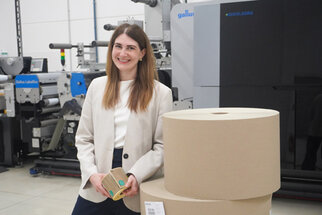
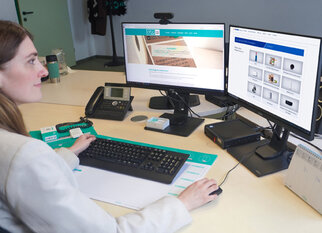
How do you quickly convince customers of sustainable labelling solutions – and create clarity despite the now enormous variety of materials and increasing regulatory pressure? At D.O.G. Label in Vienna, Austria, they rely on HERMA’s digital GreenGuide and have already impressed several customers with it. The GreenGuide is a tool that is probably unique to date. With just three or four single criteria, such as packaging type, desired sustainability aspect and material, it provides a meaningful basis for decision-making when selecting a suitable self-adhesive material. Anna-Carin Speneder-Magnet, Head of Business Development at D.O.G. Label, discovered the tool at last year’s Fachpack. “I found it fascinating how easily and systematically it guides you to a sensible solution that can be implemented straight away,” she says. “The second advantage is: I don’t just use the GreenGuide to inform myself. I can also use it to guide customers towards sustainable solutions in a targeted way, without overwhelming them.” This is particularly well received in the sectors where D.O.G. Label has a focus – food, pharmaceuticals and cosmetics. For instance, she recently found a solution together with a customer for applying labels directly to fruit and vegetables. With just a few clicks, they jointly identified a self-adhesive material whose label material and adhesive are certified by DIN CERTCO GmbH for home and garden composting in accordance with NF T51-800:2015. “We then implemented it exactly as planned – and the customer was very satisfied.”
Taking a holistic and expert view of packaging
The GreenGuide’s almost playful approach also helps to flesh out concepts or ideas that are often still rather vague: “We can certainly sense that interest in sustainable solutions in general has risen sharply among our customers,” explains Speneder-Magnet. “But when it comes to the details, there are still significant gaps in knowledge, particularly regarding the specific implications of the new EU Packaging and Packaging Waste Regulation, the PPWR.” For instance, it is still little known that extended producer responsibility (EPR) comes with an obligation to bear the costs. From 2028 onwards, for example, the material, recyclability and recycled content of the entire packaging – including labels – are to be taken into account when calculating the fees. The fee difference between good and poor recyclability is expected to be very large: A factor of 10 is to be expected. “This is information that absolutely must be factored in, particularly when considering costs,” emphasises Speneder-Magnet. “Of course, ideally everyone wants price-neutral solutions. But if that cannot always be achieved in full, it makes sense to always offset impending EPR fees against slightly higher material costs. That really opens some customers’ eyes.” This is where D.O.G. Label has a major advantage. The company can draw on extensive expertise to take a holistic view of packaging: D.O.G. Label is part of D.O.G. GmbH, headquartered in Darmstadt, Germany. The latter, in turn, specialises in sophisticated packaging requirements, particularly for the pharmaceutical and cosmetics industries. “Against this backdrop, we pursue a very credible holistic consulting approach that takes the entire packaging process into account,” says Speneder-Magnet. In any case, D.O.G. Label takes the issue of sustainability very seriously. The industrial plant generates 165,000 kWh per year with its own photovoltaic system, thereby saving 55 tonnes of CO2. The company’s own bee colonies not only provide high-quality honey but also help the environment. Furthermore, the first sustainability report is firmly planned, and the company is aiming for a silver medal in the EcoVadis assessment.
An easy introduction to sustainability
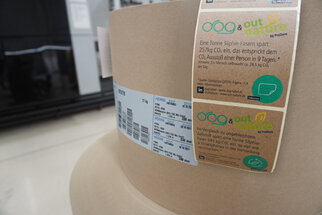
Of course, a digital GreenGuide cannot simply bridge the information gap on the customer’s side. “But it significantly lowers the barriers for customers to engage with the topic in the first place and to explore new approaches,” says Anna-Carin Speneder-Magnet, speaking from her experience to date. The sustainable materials portfolio also includes HERMAsilphie, for example. “It uses paper made from fibres of the environmentally friendly – and, above all, bee-friendly – silphium plant and, thanks to its appearance, is ideally suited for the green packaging of sustainable products, particularly in the cosmetics and food sectors. With the help of the digital HERMA GreenGuide, some customers are realising that taking the first or second step towards sustainability isn’t actually that complicated.” And as the Chinese proverb has a special saying: “Even the longest journey begins with a single step.”