


Self-adhesive material for demanding conditions in the food industry
In the food industry, an adhesive material must do more than just look good. Labelling takes place at high speeds, on damp and cold surfaces, and increasingly using a contactless ‘blow-on’ process. Under these conditions, the adhesive assembly comprising the label material, pressure-sensitive adhesive and backing material must adhere reliably whilst remaining easy to process.
Added to this are legal requirements. Pressure-sensitive adhesives designed for direct contact with greasy foodstuffs are now standard. Particularly with conventional film packaging, it is essential to ensure that neither the pressure-sensitive adhesive nor the label material migrates into the food, as the packaging film alone does not provide a sufficient barrier.
Technical requirements
- High initial tack for high-speed dispensing systems
- Reliable adhesion to damp and cold surfaces
- Resistance to oils, greases and moisture
- Flexible and pliable for contoured and deformable packaging
- Stable and adaptable
- Good die-cutting properties for clean further processing
- No-label look for transparent applications
Application-specific requirements
- Contactless labelling using the blow-on method
- Frozen food labelling
- Pasteurisation
- (Re)sealable labels
Legal requirements
- ISEGA approval for direct food contact, including with fatty foods
- Compliance with Framework Regulation (EC) No 1935/2004 and the LFGB
- Compliance with migration limits under the Plastics Regulation (EU) No 10/2011
- Compliance with BfR recommendations; for paper products, e.g. Recommendation XXXVI
- Compliance with FDA requirements (21 CFR), where required for the target market
- REACH compliance
Migration-safe pressure-sensitive adhesives for direct contact with food
Consumers are paying increasing attention to what might leach from packaging into food. In a Europe-wide survey conducted by the consumer organisation BEUC, around 70 per cent of respondents stated that they were concerned about the health effects of chemicals in food packaging. For food manufacturers, this means keeping the risk of migration as low as possible. This applies not only to the packaging film, but also to the label material and the adhesive.
To meet this requirement, HERMA has developed the two-layer 62Dps adhesive, which has an extremely low tendency to migrate. It is permitted to come into direct contact with both dry and moist foodstuffs and is also suitable for fatty foods, to which a correction factor of at least 3 may be assigned in accordance with Regulation (EU) No 10/2011. The 62Dps really comes into its own on packaging films. Thanks to its very high initial tack, it also achieves optimum results in high-speed dispensing systems, such as in the blow-on process.
HERMA offers the 62Gpt adhesive as a low-migration alternative for particularly challenging environments and conditions.
Our solution: multi-layer coating technology
For a long time, high tack and low migration were considered difficult to reconcile. A pressure-sensitive adhesive with very good adhesion tends to migrate more readily, whilst an adhesive with low migration often has weaker adhesion. HERMA resolves this conflict of objectives by applying a multi-layer coating to the pressure-sensitive adhesive. At the heart of the technology is a special intermediate layer. This enables significantly higher tack whilst also helping to minimise the migration of components into the food. HERMA pressure-sensitive adhesives thus meet both sets of requirements: demanding labelling under difficult conditions and safety in direct contact with food. The migration-safe pressure-sensitive adhesive 62Dps is also based on this technology.
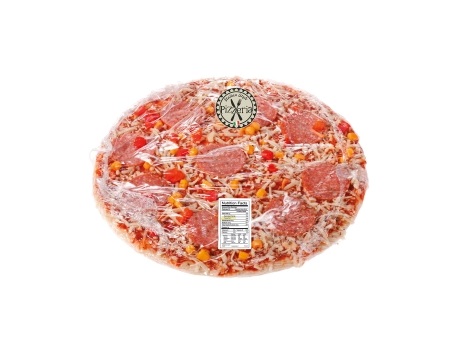
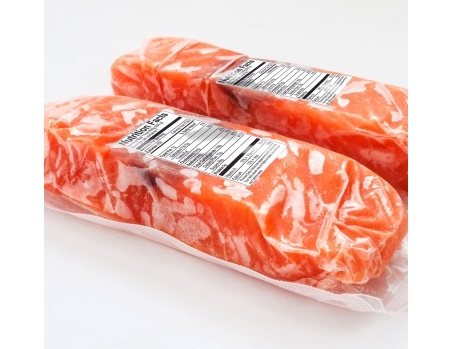
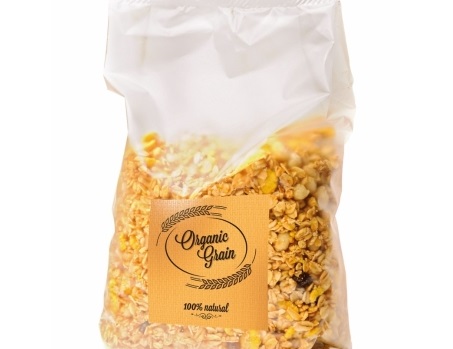
A list of all adhesive composites that are suitable for the food industry can be found in our product catalogue on page 54.
Catalogue